‏إظهار الرسائل ذات التسميات geometry. إظهار كافة الرسائل

الثلاثاء، 28 ديسمبر 2010

what is the type of the triangle

there are three types of triangle and you can go to scalene triangle ,isosceles triangle and equilateral triangle
to get information about type of triangles but now we want to find out the type of  any triangle with out drawing it 
to do this we check the Lengths of the three sides :

1 - if the square of tallest  side < the sum square of the length of the other side so it is acute triangle.


2 -if the square of tallest  side = the sum square of the length of the other side so it is right triangle.


3-if the square of tallest  side > the sum square of the length of the other side so it is obtuse triangle.


example : abc is triangle find the type of triangle as ab = 3 cm , bc = 4 cm , ca= 5 cm :

to solve this we search for the tallest side which is ca = 5 cm so ca^2 = 25 . ab^2 + bc^2 = 9 + 16 = 25 ,so ca^2 = ab^2 + bc^2 so it is right triangle


الأربعاء، 15 ديسمبر 2010

way to get area of any simple polygon

Pick's theorem

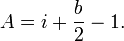
this theorem give us a simple formula for calculating the area of any simple polygon constructed on a grid of equal-distanced points. 


i =interior points located in the polygon
b=boundary points placed on the polygon's perimeter

example : In this simple polygon constructed on a grid of equal-distanced points then i = 39 (interior points located in the polygon) and b = 14(boundary points placed on the polygon's perimeter) then

A =  39 + 14/2   -1 = 45 square units


example 2 :  in this simple polygon constructed on a grid of equal-distanced points 
i = 5 and b = 7 then A = 5 + 7/2 - 1 = 7.5 square units


الاثنين، 13 ديسمبر 2010

formulas for area of triangle

area =  ah/2


there is big rectangle made up by two smaller rectangles 

the area of the first = hd  and  area of the second = he

the first rectangle is divided by two triangles. area of these triangles = hd/2

the second rectangle is divided by two triangles. area of these triangles = he/2

thanks to "ElliottMK1" for Correction


since the big triangle is made up by two triangles whose areas are hd/2 and he/2 

then area of big triangle = area of the two triangles = hd/2 + he/2 = h/2 [ d + e] = ha/2


-------------------------------------------------------------

area = (ab/2) sin C

to proof this we know that area = ah/2 
also sin c = opposite / hypotenuse = h/b
then h = b sin C then area = (ab/2) sin C

------------------------------------------------------------

by use vectors
area = 


to proof this Let vectors AB and AC point respectively from A to B and from A to C
then.the area of parallelogram ABDC is  


The area of triangle ABC is half of area of parallelogram ABDC

area of  triangle ABC


now we can write tha area of triangle ABC in dot product


now we will write vector AB = (x1,y1) and AC = (x2,y2) then the area will be


----------------------------------------------------------

Using coordinates

let vertex A is located at the origin (0, 0) and the coordinates of the other two vertices are given by B = (xB, yB) and C = (xC, yC), then the area can be computed as ½ times the absolute value of the determinant


For three general vertices, the equation is:


In three dimensions, the area of a general triangle {A = (xA, yA, zA), B = (xB, yB, zB) and C = (xC, yC, zC)} is the Pythagorean sum of the areas of the respective projections on the three principal planes
 (i.e. x = 0, y = 0 and z = 0):


----------------------------------------------------------------------

Heron's formula.

from Pythagoras's theorem a=d+e, b2=h2+d2, and c2=e2+h2. then 
d = (b2-h2) and and c2 =(a-d)2+h
then  c2  = a2-2 X a X d + b2 = a2-2 X a X √(b2-h2)+b
then h=(4 X aX b2-(a2+b2-c2)2)/(2 X a) 
then h = √((a+b+c) X (-a+b+c) X (a-b+c) X (a+b-c))/(2 X a).

area  = ah/2 = a X ((a+b+c) X (-a+b+c) X (a-b+c) X (a+b-c))/(2 X a) = 

((a+b+c) X (-a+b+c) X (a-b+c) X (a+b-c))/4 = 

(((a+b+c)/2) X ((-a+b+c)/2) X ((a-b+c)/2) X ((a+b-c)/2))

take s = (a+b+c)/2. then

area = √(s X (s-a) X (s-b) X (s-c))


------------------------------------------------------------------

Using Pick's Theorem

Pick's theorem for a technique for finding the area of any arbitrary lattice polygon.
The theorem states:


where I is the number of internal lattice points and B is the number of lattice points lying inline with the border of the polygon.

there are other area formulas i will show them later 

thanks
MR HESHAM


الأحد، 12 ديسمبر 2010

scalene triangle ,isosceles triangle and equilateral triangle

Triangle is one of the basic shape of geometry .triangle is a polygon with three vertices and three sides.We can classified  triangles by two ways :

1 ) By relative lengths of sides :

  •  the triangle in which all sides are equal is called equilateral triangle. the equilateral triangle is regular polygon with all angles measuring 60° .

  • The triangle in which two sides are equal in length is called isosceles triangle. in this triangle there two two angles of the same measure which are opposite to the two sides of the same length according to the Isosceles triangle theorem.


  • The triangle in which all sides are unequal is called scalene triangle . The three angles are also all different in measure.


2) By internal angles :

right triangle has one of its interior angles measuring 90° and The side opposite to the right angle is the hypotenuse and The other two sides are called the legs of the right angle. hypotenuse is the longest side in the right triangle. we can get the length of the hypotenuse by using Pythagorean theorem


a is hypotenuse and b , c are legs of the right angle


acute triangle has all interior angles are less than 90°


obtuse triangle has has one angle that measures more than 90°


الجمعة، 3 ديسمبر 2010

The Importance Of Geometry Formulas

Geometry formulas play an integral role in the learning of Geometry, the science of spatial relationships. It may frighten you at start, but once you master them you will feel fascinated applying them in math problems. The formulas are not only used in maths but also in other major subjects such as physics, engineering, navigation etc. That is the reason tutors always stress the importance of learning the basic formulas of Geometry. History Of Geometry The term Geometry has been coined from the two Greek words Earth (Geo) and measure (metria). The science that is extensively studied by students and widely applied in many areas nowadays had been invented and used for the first time by the Greeks. It is evident from the ruins they have left behind that they had a very good understanding of the science related to measuring shapes, angles, areas and distances. Based on the geometric principles employed by different groups of ancient people, the science is broadly classified into early geometry, Egyptian geometry, Babylonian geometry, Greek geometry, Hellenistic geometry, Indian geometry and Chinese geometry. Brain And Geometry According to a May 23, 1988 report entitled "Plane Facts on Geometry," in the Los Angeles Times, "The brain apparently uses simple geometric calculations to instantly figure out depth and distances, but researchers say they do not know if the ability is learned or inherited." In the post, Times staff and wire reports have been quoted as having said, "Scientists at the Smith-Kettlewell Eye Research Institute in San Francisco, who are studying how the nervous system enables people to see in three dimensions, have found that the brain uses either innate or learned geometric principles." Geometry In Real Life Geometry formulas that help in making variety of engineering or navigation based calculations are sometimes very helpful in real life situations also. For instance, when you plan to paint your living room, you need to know the area of the wall that has to be painted so that you can purchase the paint accordingly. Here is another instance. Farmers that want to buy fertilizers for their farm land need to know the area of the land that needs fertilizers. Therefore, people that belong to all sectors need to have a sound knowledge of basic geometry formulas and how to apply them practically. Here is a list of basic formulas that one needs to know for sure: 1.Perimeter of triangle, rectangle, square and circle 2.Area of triangle, rectangle, square, circle, parallelogram and trapezoid 3.Volume of cube, sphere, cylinder, cone and pyramid 4.Surface area of cube, sphere, cylinder, cone, pyramid and trapezoid. Some of the theorems of geometry that students may find useful are Euclid's First Theorem, Line Intersection Theorem, Betweenness Theorem, the highly reputed Pythagorean Theorem and Right Angle Congruence theorem. The knowledge of Geometry is believed to be very important in life. When students get used to applying geometry formulas in their mathematical/science/engineering curriculum at various evaluation levels, their analytical and logical thinking improves gradually. So, learning and applying the formulas will help you excel mentally as well as mathematically.


by John Gardner

الثلاثاء، 30 نوفمبر 2010

some tips to make geometry easy

If geometry hard here their are some tips to make it easy. I should say before mention tips that if you don't have high preparedness and very good will to improve your geometry grade then this article will not be useful for you and you will waste your time.


1)Geometry is very easy to understand. Always start with the basic shape properties in proving theorems.

2)Understand the problem. Determine what is given and what is needed. Master the basic properties of shapes.

3)Memorize the theorems, postulates and axioms.

4)Study the usage of squares, calculator, and ruler to create realistic diagrams.

5)Try to change or translate theoretical problems to practical problems has relationship with reality.

6) You have 150 000 000 000 cell in your brain then concentrate and translate the problem with pictures and diagrams as illustration..

7)Learning does not take place in a day. It takes continuous studying, perseverance and commitment to master the subject.

8) at the end their is  very important tip Solve as many problems as possible for practice.


I wish this is useful for you 
thanks
mrHesham

السبت، 27 نوفمبر 2010

geometrical Truth constant π


 It is mathematical constant used in mathematics and physics frequently. Symbol π is taken from the small Greek letter Pi.It is ratio between the circumference and diameter. It is real number can not be written in the form a / b where a, b integers.

It is not known how and when the man discovered that the ratio between the circumference and diameter.But it is certain that this truth has been known since ancient times. Ancient Civilizations  Egyptian and Babylonian dealt with pi. Archimedes find method To calculate the approximate value of (pi) and he found that pi Exists between 22/7 and 221/73 .In the following centuries astronomers interest to check  the approximate value of π, and astronomers Indians and Chinese created several formulas for the value of the approximate.

π is Used in other Science Such as physics and probability
such as :


         Cosmological constant
\Lambda = {{8\pi G} \over {3c^2}} \rho
     Einstein equations in general relativity 

 R_{ik} - {g_{ik} R \over 2} + \Lambda g_{ik} = {8 \pi G \over c^4} T_{ik}
        Probability density function
    f(x) = \frac{1}{\pi (1 + x^2)}.


      الجمعة، 26 نوفمبر 2010

      Proof of Pythagorean theorem

      Let ABC represent a right triangle, with the right angle located at C, as shown on the figure. We draw the altitude from point C, and call H its intersection with the side AB. Point H divides the length of the hypotenuse c into parts d and e. The new triangle ACH is similar to triangle ABC, because they both have a right angle (by definition of the altitude), and they share the angle at A, meaning that the third angle will be the same in both triangles as well, marked as θ in the figure. By a similar reasoning, the triangle CBH is also similar to ABC. The proof of similarity of the triangles requires the Triangle postulate: the sum of the angles in a triangle is two right angles, and is equivalent to the parallel postulate. Similarity of the triangles leads to the equality of ratios of corresponding sides:
       \frac{a}{c}=\frac{e}{a} \mbox{ and } \frac{b}{c}=\frac{d}{b}.\,

      The first result equates the cosine of each angle θ and the second result equates the sines.
      These ratios can be written as:

      a^2=c\times e \mbox{ and }b^2=c\times d. \,
      Summing these two equalities, we obtain
      a^2+b^2=c\times e+c\times d=c\times(d+e)=c^2 ,\,\!
      which, tidying up, is the Pythagorean theorem:
      a^2+b^2=c^2 \ .\,\!


      الاثنين، 22 نوفمبر 2010

      Pythagorean theorem

      Pythagorean theorem One of the most important theories of geometry 

      Pythagorean theorem : In any right triangle, the area of the square whose side is the hypotenuse (the side opposite the right angle) is equal to the sum of the areas of the squares whose sides are the two legs (the two sides that meet at a right angle).

      Pythagorean theorem can be written as an equation relating the lengths of the sides a, b and c

      a^2 + b^2 = c^2\!\,
      where c represents the length of the hypotenuse, and a and b represent the lengths of the other two sides.

      there are other forms 
      if  we know :
      a & b  
       c = \sqrt{a^2 + b^2}. \,


      c & b

      a = \sqrt{c^2 - b^2}. \,


      a & b
      b = \sqrt{c^2 - a^2}. \,